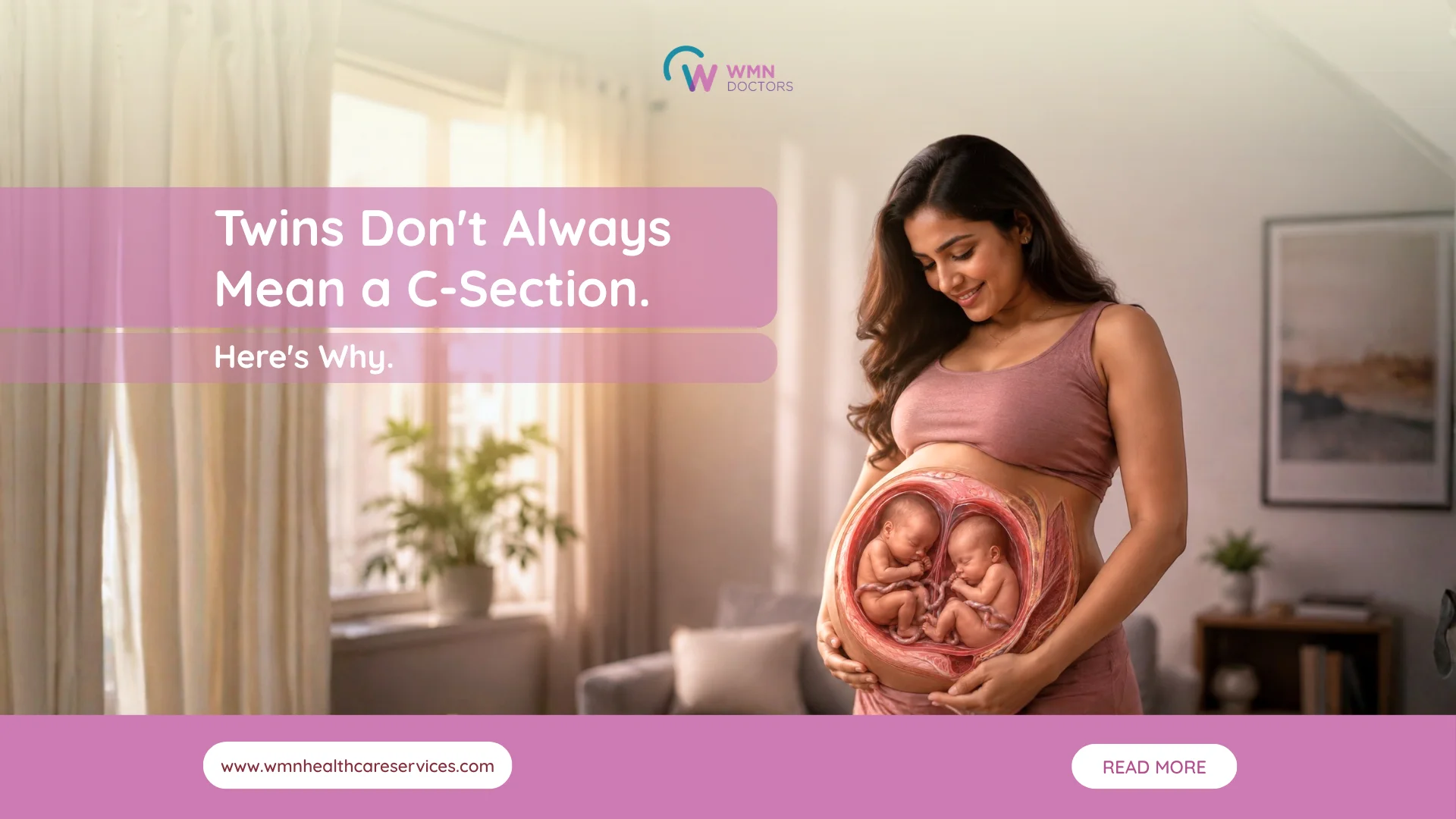
Twins Don’t Always Mean a C-Section. Here’s Why.
A twin pregnancy comes with double the excitement — and usually, double the questions. One of the most common ones we hear: “Will I have to have a C-section?”
The honest answer is: not necessarily. With the right monitoring, favorable baby positions, and experienced medical care, a safe vaginal delivery is possible for many twin pregnancies.
Why the C-Section Myth Persists
Twin pregnancies are automatically placed in the high-risk category, and high-risk often gets mentally translated into “will need surgery.” But high-risk means closer monitoring — not a predetermined outcome. The actual mode of delivery depends on several specific factors that are assessed as the pregnancy progresses, not decided the moment twins are confirmed.
What Actually Determines the Delivery Method
Baby positioning. This is the biggest factor. If both babies are head-down (vertex-vertex), a vaginal delivery is often possible. If the first baby is head-down and the second is breech, vaginal delivery may still be an option depending on the doctor’s assessment. If the first baby is breech, a C-section is usually recommended.
Gestational age and growth. Babies growing well and reaching a safe gestational age support the case for a trial of vaginal delivery.
Whether the twins share a placenta. Twins can be dichorionic (separate placentas) or monochorionic (shared placenta). This affects risk levels and the monitoring plan, which in turn influences delivery recommendations.
Any pregnancy complications. Conditions like preeclampsia, placenta previa, or poor fetal growth can shift the plan toward a C-section for safety.
Access to the right medical setup. A vaginal twin delivery requires a hospital equipped to handle both babies simultaneously, with a team ready to respond quickly if the plan needs to change mid-delivery. This is why the experience and infrastructure of your care team genuinely matters here.
What “Closer Monitoring” Actually Looks Like
Twin pregnancies typically involve more frequent ultrasounds to track each baby’s growth individually, closer monitoring for preeclampsia and gestational diabetes, and regular checks on baby positioning as the due date approaches. None of this is about assuming something will go wrong — it’s about having enough information to make a safe, informed call on delivery as the pregnancy nears term.
Myth vs Fact
Myth: All twin pregnancies need a scheduled C-section. Fact: Many twin pregnancies are strong candidates for vaginal delivery, depending on positioning and how the pregnancy is progressing.
Myth: If the first baby is delivered vaginally, the second one will be too. Fact: Usually, but not always. Doctors monitor the second baby closely after the first delivery, and if their position or condition changes, the plan can shift — including, in some cases, to a C-section for the second baby only.
Myth: A vaginal twin delivery is riskier than a planned C-section. Fact: When conditions are favorable and it’s managed by an experienced team in a well-equipped facility, vaginal delivery is a safe option — not an inherently riskier one.
The Bottom Line
There’s no single “right” way to deliver twins. The best birth plan comes from ongoing monitoring, an honest look at how your specific pregnancy is progressing, and a care team experienced enough to adapt if the plan needs to change.
At WMN Doctors, our team has managed over 120 twin deliveries in the last decade, with nearly 40% delivered vaginally under the right conditions. Every pregnancy is different — and the best outcomes start with personalized, informed care.
Book your appointment with WMN Doctors 📞 +91 8069207100 | 💬 WhatsApp: 9243052186


